Reading Words as Sounds Instead of Letters
When to Teach Alphabetic character Names
I recently received an email posing this question:
We are teaching systematic phonics to our little ones, but we are conflicted equally when to teach letter of the alphabet names. When and how should letter of the alphabet names be taught to children?"
The timing of the introduction of letter names is important, so I'll frame my thoughts using the Goldilocks principle – non too early, not also tardily, but at but the right time. It is a developmental concern, rather than a class/year- or age-related concern.
Not Likewise Early on
Should y'all teach letter names or sounds commencement?
Messages are used equally a code for the sounds in our speech and so are meaningless without cognition of the sounds. Any squiggle/shape could stand for a audio, for example:
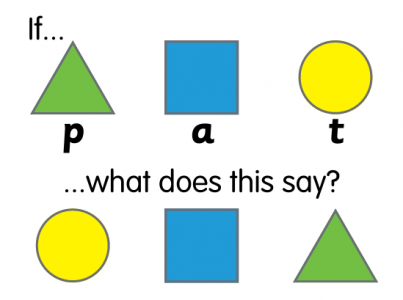 Yous still managed to read this with your new cognition of our shape code!
 Letter names provide abstract labels for the letters, not representations of how the letters actually sound within our linguistic communication. That is why educational activity a child to sing the alphabet song before the child receives formal reading instruction has limited value. The first important step towards literacy success is development of phonemic sensation and not letter proper noun singing.
Why not teach letter names and sounds together?
And so, if letters make no sense without sounds, why not teach letter sounds and names side by side? The elementary answer is because of the cognitive load. Working memory has to piece of work hardest when a task is novel and therefore has a heavy cognitive load. For the beginning learner, identifying private sounds in a word, from left to right, is quite a novel job. Forming letter shapes and discriminating between letter shapes are novel tasks. Remembering the proper noun of a letter is a novel task. Linking a specific alphabetic character with a specific sound is a novel task.
Is information technology any wonder that some children, especially those with a weak working memory, struggle with reading and spelling? Cognitive load theory makes information technology clear that we can and should do what is necessary to reduce cognitive load. Information technology is not necessary for school beginners to know the names of letters for reading and spelling, so, in my opinion, the educational activity of letter names should be postponed until letter names are necessary. This allows students to begin to write and read more quickly.
Teach letter-sound correspondences initially, without teaching letter names
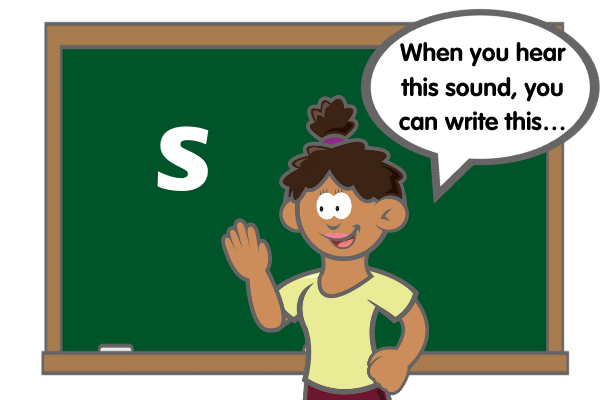
Students need to learn letter-audio correspondences for reading and spelling. When a kickoff reader is learning the single letter-sound correspondences, you do have to talk well-nigh the squiggles we make for sound symbols equally 'letters', merely that does not mean that yous should refer to the letter names. Instead, the teacher can say:
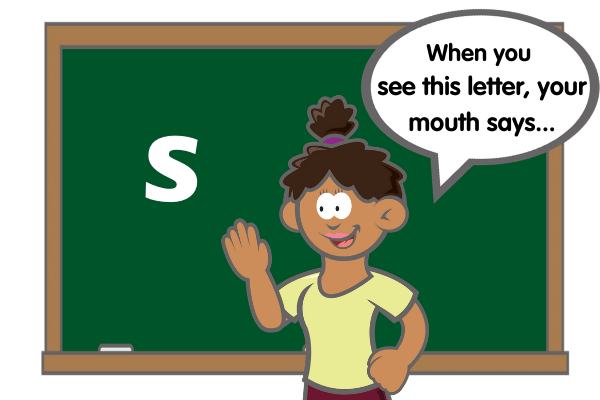
or
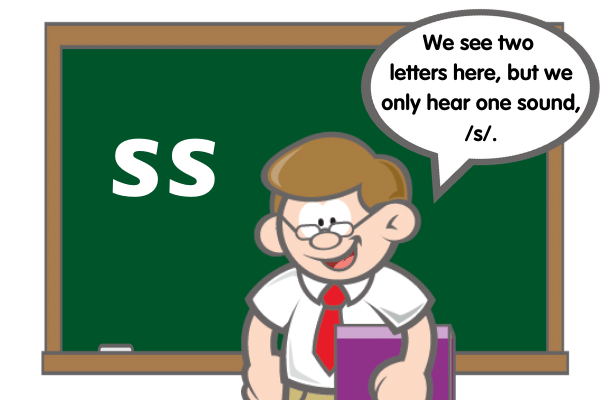
When the child is spelling, the prompt can be:
Teaching letter names as well early can confuse start readers
Alphabetic character names will not help a child to decode words: the give-and-take 'cat' is not read every bit 'seeaytee'. While some may argue that teachers can use aspects of letter names as cues for students to identify the sounds they correspond, the potential for confusion outweighs any benefits if letter names are introduced too early.
Children learning to read who accept received more instruction in letter names than letter sounds are more likely to wait at a word and read:
| Letter Name | Wrong Letter Audio |
| 'w' | /d/ (for 'doubleyou') – refers to the shape of the letter, not the sound |
| 'y' | /west/ (for 'why') |
| 'u' | /y/ (for 'you') |
| 'c' | /due south/ (for 'see') – this is less mutual than /k/ |
| 'chiliad' | /j/ (for 'jee') – this is less common than difficult /k/ |
| 'h' | long /a/ (as in 'acrawling') |
| 'f', 'l', 'k', 'n', 'southward', 'x' | short /due east/ (as in 'ef', 'el', 'egrand', 'eastwarddue north', 'es', 'ex') |
If they are taught letter names before letter sounds, get-go readers will expect vowel letters to represent a long vowel sound in words, reading, for example, 'got' as 'goat'. The most mutual sound represented by a vowel letter is its brusk sound, and it is commonly VC and CVC words, containing brusk vowel sounds, to which offset readers are first exposed.
…and get-go spellers
Children learning to spell who have received more education in alphabetic character names than letter sounds are more probable to use letter names in their spelling e.chiliad.
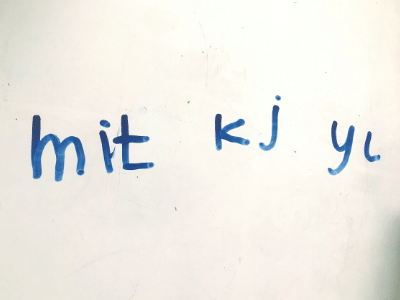 'Might', 'cage', and 'while'
 Not Too Belatedly
Information technology will be harder for a instructor to assist children who take not been taught letter names with their spelling. In the photograph below, you can see what a five-year-old, who doesn't know the letter names, produced when she asked how to spell 'edible bean' and the parent responded with letter names:
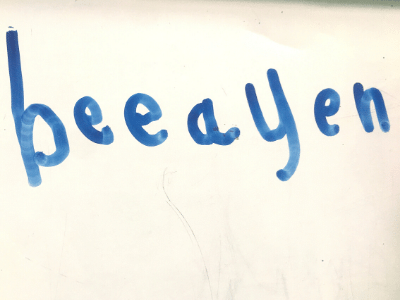 "B-E-A-N"
 If a child asks how to spell the long /ee/ audio in 'beach', it is not appropriate to say "Write /eh/ then /ah/", considering blending those sounds together does not create the long /ee/ sound. Y'all must use alphabetic character names eastward.yard. "We spell the long /ee/ sound in 'embankment' with the letter 'e' followed by the letter 'a'. They make a vowel team." Similarly, if you enquire a child how 'seek' is spelled, it is non sufficient for the child to say "/south/, long /ee/, /grand/" because there are several possible spellings for each of those sounds. Developing the linguistic communication that allows discussion of letter-audio correspondences is important to reading and spelling success.
When you lot are helping a child to encode or decode an irregular tricky word, you need to be able to draw attending to the parts that are not regular, for case past saying "The letters 'a' and 'i' together in this word, 'said', are representing the short /e/ sound." Irregular words cannot be fully sounded out so noesis of letter-sound correspondences is insufficient.
Merely the Right Fourth dimension
Research indicates that alphabetic character proper noun instruction volition actually strengthen letter audio knowledge. When a student understands the way in which the alphabetic lawmaking works, letter names become of import. Many messages have more than one possible sound, and many sounds can be produced by a variety of different letters, then it is important to be able to reference each alphabetic character independently of the audio information technology makes.
Teach letter names when they are needed:
-
To talk about culling spellings
east.g.
Teach letter names as soon every bit y'all demand to talk virtually alternate spellings in reading and/or spelling. Typically, the first time you need to practise this will be when students learn that 'c', 'one thousand' and 'ck' are all alternatives for spelling /grand/. You will need to talk about where children volition see these alternatives: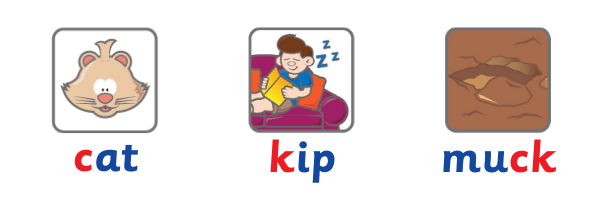
"We usually see the letter 'grand' representing /one thousand/ before an 'e' or 'i' at the beginning of a word."
"The letter 'c' usually represents /k/ earlier an 'a', 'o' or 'u'."
"We employ the messages 'c' and 'k' together after a weak vowel at the end of a word."
Letter names must be taught for word of digraphs east.thousand. "Because we have 44 sounds but only 26 letters in English, we have to combine some letters. The two-alphabetic character combination of 'c' and 'h' represents the sound /ch/." When the alternative spellings of long /ee/ are taught (ea, ee, ie, ei, ey) information technology is no longer sufficient to just refer to 'two-letter e' – y'all must name the vowels that tin can be combined to correspond a vowel sound, and their club.
-
To talk about uppercase letters
If yous are teaching students about the utilize of a upper-case letter letter at the beginning of a sentence or proper name, yous must refer to a alphabetic character name. There is no such affair as a capital sound! You lot will too need to refer to letter of the alphabet names when helping children to recognise letters when reading text in unlike fonts. -
To communicate the spelling of a word to someone else
Familiarity with letter names allows the teacher to respond, from a altitude, to the question "How do I spell the /ie/ in 'nighttime'?" with "It'due south the i-g-h spelling", rather than having to go and write it down for the kid. When someone asks you to spell your proper noun, exercise yous give him/her the sounds of your name or do you provide the letter names? Of course, you give the latter. Not to do and then would require the person to go through every alternative representations of the sounds and brand a selection. That could have a lot of fourth dimension if your name was derived from another alphabet, like 'Siobhan'! Consequently, a instructor may have to teach specific alphabetic character names earlier to a child with a name that cannot be sounded out hands or has an unusual spelling. -
To teach homophones
When the sounds of ii words are the same, you must be able to draw them using their letter names. e.g. "The 'bean' you eat is spelled with the messages 'e' and 'a', as in the word 'swallow'. The other 'been' is the past tense of 'be' and is spelled with two eastward'due south."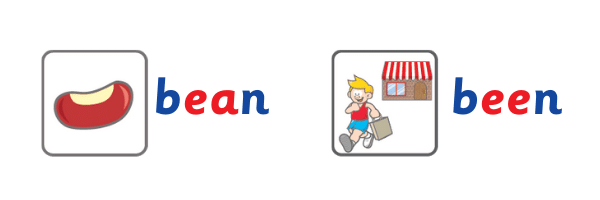
How Do Yous Teach Alphabetic character Names?
Follow the society of your synthetic phonics programme in choosing which letter names to teach, when. Using our earlier instance, the c/yard/ck culling spellings of /k/ are the start typically met in a synthetic phonics program (in level half-dozen of Phonics Hero's Playing with Sounds guild and level 2A of Letters and Sounds, so these should probably be taught first, then the letters that make up consonant digraphs (l, s, f, h, t, w, n and g).
Teach the most common alphabetic character names first, the less common alphabetic character names last (q, z, x.). Every syllable of every word must take a vowel sound and there are many alternative spellings of vowel sounds, so it is very important that students accept a audio knowledge of these.
In order to have true fluency in letter recognition, children must be able to place letters and say their names in and outside of context and in and out of sequence. It'southward not just accuracy, but too automaticity, that contributes to long-term literacy success. Here are a few ideas for developing automaticity in letter naming:
- Direct instruction: "This alphabetic character's name is __. What letter is it? Point to another ___ on the board."
- Teach letter names alongside letter of the alphabet formation. Have the kid say the name of the letter of the alphabet as he or she writes it.
-
Have a alphabetic character of the day and advantage the child for finding that letter in the classroom, in a shared book, etc. Impress our gratis Letter of the alphabet of the Day affiche and use it to display the letter at the front of your classroom.
-
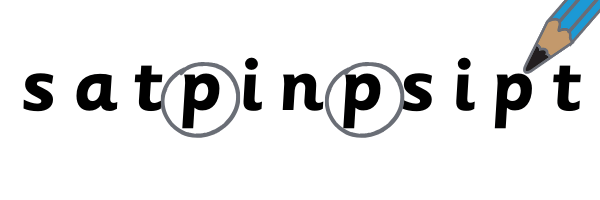
Letter searches: "Circle each letter of the alphabet 'p' in this line of messages."
- Bingo: Call out a letter name and have the child place a counter on the corresponding letter. We've created a free Alphabetic character Name Bingo template yous can use.
- Accept the educatee pull a letter out of a mystery purse, a sandbox etc and name it.
- Use the child's name and other family names to practise letter recognition.
- Print out messages on newspaper or write them with chalk. Take children jump on/run to a letter of the alphabet when you telephone call out a letter of the alphabet proper noun.
Once the student tin accurately proper name all 26 letters, return your focus to letter-audio correspondences. There are many more sounds than messages to learn and cognition of those correspondences are fundamental to reading and spelling successfully!
Still have questions most how or when to teach letter of the alphabet names to children? Get out us a comment below!

Author: Shirley Houston
With a Masters degree in Special Didactics, Shirley has been pedagogy children and training teachers in Australia for over thirty years. Working with children with learning difficulties, Shirley champions the importance of teaching phonics systematically and to mastery in mainstream classrooms. If you are interested in Shirley's aid as a literacy trainer for your school, drib the team an e-mail on info@phonicshero.com
Reading Words as Sounds Instead of Letters
Source: https://phonicshero.com/teach-letter-names/
0 Response to "Reading Words as Sounds Instead of Letters"
Post a Comment