Reading Staar Test Strategies for High School
Are you scoring in the 600-750 range on Saturday Reading + Writing? Do yous want to raise that score every bit high as possible—to a perfect 800? Getting to a perfect Sabbatum Reading test score isn't easy. It'll require perfection. But with difficult work and my strategies below, you'll be able to do it. I've consistently scored 800 on Reading on my real SATs, and I know what it takes. Follow my advice, and you'll get a perfect score—or get very shut. Cursory note: This article is suited for avant-garde students already scoring a 600 on SAT Reading or above (this equates to a Reading Test Score of 30+ out of 40). If you're below this range, my "How to Improve your Sat Reading Score to a 600" commodity is more advisable for you. Follow the Sabbatum Reading tips in that article, then come back to this one when you lot've reached a 600. Also, the SAT has a single 800 Reading + Writing score, combining the private Reading and Writing exam scores. Technically, when I mention a perfect Reading exam score, I'm referring to a perfect twoscore/xl test score, which is essential to getting an 800 Reading and Writing score. In this guide, I'll apply 800 and 40 interchangeably to hateful a perfect Reading score. We won't talk near Writing here, but if you lot want to meliorate your Writing score too, check out my Perfect Saturday Writing score guide. Virtually guides on the cyberspace on how to score an 800 are pretty low quality. They're often written by people who never scored an 800 themselves. You can tell because their advice is usually vague and not very pragmatic. It's non enough to be reminded of elementary Reading tips similar "don't forget to gauge on every question!" In contrast, I've written what I believe to be the all-time guide on getting an 800 available anywhere. I take confidence that these strategies work because I used them myself to score 800 on SAT Reading consistently. They've also worked for thousands of my students at PrepScholar. In this commodity, I'm going to discuss why scoring an 800 is a skilful thought, what it takes to score an 800, and and so go into the 11 cardinal Sat Reading strategies then you know how to go a perfect SAT Reading score. Stick with me—equally an advanced pupil, yous probably already know that scoring high is proficient. Just it's important to know why an 800 Reading and Writing score is useful, since this volition fuel your motivation to get a high score. This guide has been updated for the current Sat, and so yous can exist sure my advice works for the test you're almost to take. Final note: in this guide, I talk mainly about getting to an 800. But if your goal is a 700, these strategies still as apply. Let's make something clear: a 1550+ on an SAT is equivalent to a perfect 1600. No tiptop college is going to requite you more credit for a 1590 than a 1550. You've already crossed their score threshold, and whether you make it at present depends on the rest of your application. And so if you're already scoring a 1550, don't waste your time studying trying to get a 1600. You're already set for the superlative colleges, and information technology's fourth dimension to work on the rest of your awarding. But if yous're scoring a 1540 or below and you desire to go to a summit ten college, information technology's worth your time to push your score upwardly to a 1550 or above. At that place'south a large deviation between a 1450 and a 1550, largely considering information technology'due south easier to get a 1450 (and a lot more than applicants do) and a lot harder to get a 1550. A 1540 places yous correct effectually average at Harvard and Princeton, and being average is bad in terms of Ivy League-level admissions, since the admissions rate is typically below ten%. Then why get an 800 on SAT Reading+Writing? Considering it helps y'all compensate for weaknesses in other sections. More often than not, schools consider your composite score more so than your individual section scores. If you can become a perfect 40 in Sat Reading, yous can become a 39 in Sat Writing (for a total of 790 in Reading + Writing) and a 760 in SAT Math and withal be confident about your exam scores. This gives you a lot more flexibility. Harvard'due south 75th percentile Reading score is 780. At that place's another scenario where an 800 in Sabbatum Reading is actually important. If yous're planning to use as a humanities or social science major (like English language, political science, communications) to a top school. Here's the reason: college admissions is all most comparisons between applicants. The school wants to acknowledge the best, and y'all're competing with other people in the same "bucket" as you lot. By applying as a humanities/social scientific discipline major, you're competing confronting other humanities/social scientific discipline folks: people for whom Sat Reading is piece of cake. Really easy. Here are a few examples from schools. For Harvard, Princeton, Yale, and U Chicago, the 75th percentile Sabbatum Reading score is a 770 or above. That means at least 25% of all students at these schools have a 770 in Sat Reading. But if you tin work your way to an 800, y'all show that you're at an equal level (at least on this metric). Even if it takes you a ton of work, all that matters is the score you attain at the end. I'll be honest—Sat Reading wasn't my strong accommodate in loftier schoolhouse. When I started studying, I was scoring around the 700 range. I was always stronger in math and scientific discipline. But I learned the tricks of the test, and I developed the strategies below to raise my score to an 800. At present I'm sharing them with you. This isn't just some fuzzy feel-skilful message you see on the back of a Starbucks cup. I mean, literally, you and every other reasonably intelligent student tin can score a perfect SAT Reading score. The reason almost people don't is they don't try hard plenty or they don't study the right mode. Even if language isn't your strongest arrange, or you lot got a B+ in AP English, you're capable of this. Considering I know that more than than anything else, your SAT score is a reflection of how hard you piece of work and how smartly you study. Here's why: the Saturday is a weird test. When yous have information technology, don't you get the sense that the questions are cypher like what you've seen in schoolhouse? I bet you've had this problem: in Sabbatum Reading passages, you ofttimes miss questions because of an 'unlucky guess.' You'll try to eliminate a few answer choices, and the remaining reply choices will all sound equally expert to you. Well, you throw up your easily and randomly judge. This was one of the major issues for myself when I was studying SAT Reading, and I know information technology affects thousands of my students at PrepScholar. The SAT is purposely designed this fashion to confuse yous. Literally millions of other students have the exact same problem you lot do. And the SAT knows this. Normally in your school's English language class, the instructor tells you that all interpretations of the text are valid. You can write an essay well-nigh anything you want, and English teachers aren't (normally) allowed to tell you lot that your stance is wrong. This is considering they tin arrive trouble for telling you lot what to think, especially for complex issues similar slavery or poverty. But the Sabbatum has an entirely different trouble. Information technology's a national test, which means it needs a level playing field for all students effectually the land. It needs a solid test to compare students with each other. Every question needs a single, unambiguously, 100% correct answer. At that place's only ever one right respond. Find a way to eliminate three incorrect answers. Imagine if this weren't the example. Imagine that each reading respond had two answer choices that might each be plausibly correct. When the scores came out, every single educatee who got the question wrong would complain to the College Lath about the test being wrong. If this were true, the Higher Board would then have to invalidate the question, which weakens the power of the exam. The College Lath wants to avoid this nightmare scenario. Therefore, every unmarried Reading passage question has simply i, unmarried correct respond. But the SAT disguises this fact. It asks questions like: Notice a design here? The Sabbatum always disguises the fact that in that location'south ever i unambiguous respond. Information technology tries to Brand you waver betwixt 2 or 3 answer choices that are virtually likely. And then you guess randomly. And and so you get it wrong. You lot can bet that students autumn for this. Millions of times every year. Students who don't prepare for the Sat in the right way don't appreciate this. But, if you ready for the SAT in the correct style, you'll learn the tricks the SAT plays on you. And you lot'll raise your score. The Saturday Reading section is full of patterns like these. To improve your score, you just need to: The point is that you tin can learn these skills, even if you don't consider yourself a good reader or a great English language student. I'll get into more detail about exactly how to do this. One last indicate: permit's brand sure we understand how many questions we can miss to score an 800. If we accept a target score in mind, it helps to understand what you demand to get that score on the actual test. There are 52 questions in the Reading department, and how many questions yous miss determines your scaled score out of twoscore. From the Official Sabbatum Do Tests, I've taken the raw score to scaled score conversion tables from 4 tests. (If you could use a refresher on how the Saturday is scored and how raw scores are calculated, read this.) These grading scales are harsh. For tests two and four, if you miss but one question, you go dropped down to a 39. This ways your maximum Reading + Writing score is a 790. For tests 1 and 3, if you miss one question, y'all're notwithstanding at a perfect 40, but miss another and you drop down to a 39. The scoring nautical chart curve depends on the difficulty of the test. The harder the test, the easier the bend. But you can't predict what kind of examination yous're going to get on test day. The safest matter to do is to aim for perfection. On every practice test, you lot need to aim for a perfect raw score for an 800. Whatever you're scoring now, take note of the difference you need to become to a 800. For example, if you're scoring a 35 raw score, you demand to respond half-dozen to seven more than questions right to go to a perfect 40 and an 800. As a final example, here'south a screenshot from my exact score report from March 2014, showing that I missed one question and earned an 800. (This was from the previous 2400 version of the Saturday, but it had a like grading scale). OK—so nosotros've covered why scoring a higher Reading score is important, why you specifically are capable of improving your score, and the raw score you need to get to your target. At present we'll get into the meat of the article: actionable strategies and reading tips that you should use in your ain studying to maximize your score improvement. What's your greatest weakness? Every student has different flaws in Sabbatum Reading. Some people don't have expert strategies for tackling the passage questions. Others don't manage their time correctly and run out of time earlier getting through all the questions. Here's how you can figure out which 1 applies more than to you: Go what we're doing here? By marker which questions you did under Extra Time, we can figure out what score you lot got if yous were given all the fourth dimension you needed. This will help the states figure out where your weaknesses lie. If you didn't take any actress time, then your Extra Fourth dimension score is the same equally your Realistic score. Here'south a flowchart to assist you figure this out: Was your Extra Time score a 35 or above? If NO (Extra Time score < 35), then you have strategy and content weaknesses. All the extra time in the earth couldn't get you above a 35, and so your get-go angle of set on will exist to observe your weaknesses and attack them (We'll cover this afterwards). If YES (Actress Time score > 35), then: Was your Realistic score a 35 or in a higher place? If NO (Actress Time score > 35, Realistic < 35), then that means you have a difference between your Extra Time score and your Realistic score. If this deviation is more than 3 points, so you take some big issues with fourth dimension management. We need to effigy out why this is. Are y'all using the best passage reading strategy for you? Does it take you too much time to get the answer for each question? Mostly, doing a lot of practice questions and learning the most efficient passage strategies will help reduce your fourth dimension. More on this afterwards. If Yep (both Extra Time and Realistic scores > 35), then you take a really good shot at getting an 800. Compare your Extra Time and Realistic score—if they differed by more than 2 points, then you would benefit from learning how to solve questions more than quickly. If not, then you likely can do good from shoring up on your last content weaknesses and avoiding careless mistakes (more than on this strategy afterwards). Hopefully that makes sense. Typically I see that students have both timing and content problems, only y'all might observe that 1 is much more dominant for you than the other. For example, if you can get a 40 with actress time, but score a 35 in regular fourth dimension, you know exactly that you need to piece of work on time direction to get a 40. This type of analysis is and then important that it'south a central role of my prep program, PrepScholar. When a new student joins, he or she gets a diagnostic that figures out specific strengths and weaknesses. The program then automatically customizes your learning so that you're always studying according to where you lot can brand the most improvement. No matter what your weakness is, my following strategies volition accost all weaknesses comprehensively. This strategy was by far the about effective for me in raising my Reading score. It completely changed the way I viewed passage questions. I spent some fourth dimension talking above most how the SAT always has one unambiguous answer. This has a huge implication for the strategy you should utilise to find the right SAT Reading respond. Here'south the other manner to see it: Out of the 4 reply choices, three of them have something that is totally wrong well-nigh them. Only one reply is 100% correct, which means the other three are 100% wrong. You know how you attempt to eliminate reply choices, and and then cease up with a few at the end that all seem equally likely to exist correct? "Well, this can work...but and then once more this could work too..." STOP doing that. You're non doing a skillful enough job of eliminating answer choices. Recollect—every single wrong choice tin exist crossed out for its ain reasons. Yous demand to do a 180 on your arroyo to Reading questions. Instead, detect a reason to eliminate three reply choices. "Can I find a reason to eliminate this answer option? How about this one?" You have to learn how to eliminate 3 respond choices for every unmarried question. "Great, Allen. Only this doesn't tell me anything about how to eliminate reply choices." Thank you for asking. One thing to remember is that even a single word can make an respond pick wrong. Every unmarried word in each answer choice is put there past the Sabbatum for a reason. If a unmarried discussion in the answer selection isn't supported by the passage text, you demand to eliminate it, even if the rest of the respond sounds good. At that place are a few archetype wrong respond choices the SAT loves to use. Here's an example question. For instance, allow'southward imagine you just read a passage talking most how man evolution shaped the environment. It gives a few examples. Start, it talks about how the transition from earlier species similar Homo habilus to neanderthals led to more tool usage like fire, which caused wildfires and shaped the environmental. It then talks nigh Homo sapiens 40,000 years ago and their overhunting of species like woolly mammoths to extinction. So and then we encounter a question asking, "Which of the following best describes the main subject of the passage?" Hither are the answer choices: (We're using five answers for purposes of illustration—the Sat volition simply have four choices). As yous're reading these answer choices, a few of them probably started sounded really plausible to you. Surprise! Each of the answers from A-D has something seriously incorrect about it. Each 1 is a archetype example of a wrong answer type given past the Sabbatum. A: The transition betwixt Homo habilus and neanderthals This type of wrong answer focuses on a smaller detail in the passage. It's meant to pull a fast one on you lot because you might think to yourself, "well, I run across this mentioned in the passage, and so it'southward a plausible answer selection." Wrong! Call back to yourself—can this answer choice actually describe the entire passage? Can it basically role equally the title of this passage? Yous'll detect that information technology'southward just way too specific to convey the point of the overall passage. B: The study of development This type of incorrect reply has the opposite problem—it's way too broad. Yes, theoretically the passage concerns the study of evolution, but merely ane attribute of it, and especially as it relates to the affect on the environment. To give another ludicrous instance, if you lot talked to your friend about your cell phone, and he said your master signal was about the universe. Yes, you lot were talking about the universe, but merely a tiny fraction of it. This is way as well wide. C: How the environment shaped human evolution This wrong respond choice can be tricky because it mentions all the correct words. But of class the human relationship between those words needs to be correct as well. Hither, the human relationship is flipped. Students who read too apace make careless mistakes like these! D: The plausibility of evolution Finally, this kind of wrong respond preys on the tendency of students to overthink the question. If you lot're passionate about arguing about evolution, this might be a trigger answer since any discussion of evolution becomes a take chances to debate most the plausibility of evolution. Of course, this concept volition appear nowhere in the passage, but some students just won't be able to resist. Exercise you lot run into the point? On the surface, each of the reply choices sounds peradventure correct. A less prepared pupil would think that all of these were plausible answers. Merely plausible isn't good enough. The right respond needs to exist 100%, totally right. Incorrect answers might be off by even one word—you need to eliminate these. Carry this thought into every Sabbatum Reading passage question you do and I guarantee y'all will first raising your score. As we've discussed already, the SAT is designed to catalyst you into making mistakes by putting actually like answer choices side by side to each other. In Strategy 2, we covered the strategy of ruthless, unforgiving elimination of answer choices. Here's another Strategy that works well for me. Before reading the reply choices, come up up with your own answer to the question. Gaze into your crystal ball and predict the right answer. This strategy is exactly designed to counteract the trickiness of the answer choices. If you lot don't apply this strategy, your thinking process likely meanders like this: "OK, I just read the question. Answer A is definitely out. B tin can kind of work. C...it doesn't exactly fit, just I can see how it might work." and so on. By now, yous've already fallen into the College Board'due south trap of muddling the reply choices. Take the contrary approach. While you're reading the question, come upwards with your own ideal reply to the question before reading the answer choices. This prevents you lot from getting biased by the Saturday's answer choices, especially the wrong ones. If it's a "Big Motion picture" type question request well-nigh the master point of the passage, answer for yourself, "What would make a good title for this passage?" If information technology'southward an "Inference" question, answer for yourself, "What would the author call up about the state of affairs given in the question?" Even if you lot can't answer the question straight away—for case, if you have to refer dorsum to the line number to remember what the passage was saying—endeavor to solve the question before looking at the reply choices. The key hither is that the passage must back up your answer choice. Every correct answer on Sat passages needs to be justified past the passage—otherwise the answer would be ambiguous, which would cause problems of cancelling questions I referred to earlier. Warning: this merely works if yous can read and understand passages well, and if you lot have prior experience with Saturday Reading questions! That's why I don't recommend this strategy notwithstanding before you hitting a 600 level since you're more likely to come with the wrong respond choice in your head. In your prep for the Sat, yous may take read different strategies for how to read a passage and answer questions. Some students read the questions earlier reading the passage. Others read the passage in detail first. At your high level, I can't predict which method will piece of work best for you. We're going for perfection, which means that your strategy needs to line up with your strengths and weaknesses perfectly, or else you'll make mistakes or run out of time. What I will do, however, is get through the most effective methods. You'll then have to figure out through your test data which one leads to the highest score for you. This is the almost common strategy I recommend to our students, and in my optics the most constructive. I prefer this 1 myself. Hither it is: My preferred way to tackle a passage: skimming it on the showtime read-through. This strategy is a revelation for students who used to shut-read a passage and run out of time. This skimming method works considering the questions will ask about far fewer lines than the passage actually contains. For case, lines 5-20 of a reading passage might not be relevant to any question that follows. Therefore, if you spend time trying to deeply empathise lines 5-xx, you'll be wasting time. Past taking the reverse approach of going back to the passage when you lot demand to refer to it, you lot guarantee reading efficiency. You're focusing only on the parts of the passage that are important to answering questions. Disquisitional Skill: Yous must exist able to skim effectively. This means being able to rapidly assimilate a text without having to slowly read every word. If y'all're not quite skillful at this notwithstanding, do information technology on newspaper manufactures and your homework reading. This is the second about common strategy and, if used well, as constructive as the first method. Just it has some pitfalls if you don't exercise information technology correctly. Here's how it goes: Here's an instance passage that I marked up, with questions coming first. Observe that beyond underlining the phrase referenced in the question, I left clues for myself on what's of import to get out of this phrase. (questions not relating to specific lines aren't shown to a higher place) In the hands of an Sabbatum expert, this is a powerful strategy. Just similar Method i higher up, y'all save time by skipping parts of the passage that aren't asked nearly. Furthermore, you get a caput kickoff on the questions by trying to respond them beforehand. Merely there are serious potential pitfalls to this method if y'all're not careful or prepared enough. Hither'southward one: when you kickoff read the questions earlier the passage, yous won't have enough time to digest the actual respond choices (nor will they make sense to you). So y'all have to make your all-time gauge for what the question is asking when you're writing a annotation along the passage. In some cases, this can lead y'all off-target. Take this instance from above: When I read the question, I saw that it asked me to notice how Woolf characterized the questions I marked in lines 53-57. The problem is how broad the question is. How something can be characterized gives a broad range of options. Here are a number of plausible characterizations as I read the text: There's a lot of flexibility in interpretation here, since the questions actually do touch upon all these characterizations. It turns out "important" and "urgent" are the right interpretations, for reply pick C. But when I'yard reading the passage and see my annotation, I can waste material a lot of time coming upwardly with potential options that aren't even correct answer choices. In the worst case, it tin can bias me toward the wrong respond. Disquisitional Skill: Yous need to have so much experience with the SAT Reading department that yous tin can conceptualize what the question is going to ask you lot for your notes to exist helpful. If you're not certain of this, yous can easily be led down the wrong track and focus on the wrong aspect of the passage. This method is what beginner students usually use by default, considering it'due south what they've been trained to do in schoolhouse. Some beginner books similar Princeton Review and Kaplan also propose this every bit a strategy. It's my least favorite method because there are so many ways for it to go wrong. But for the sake of completeness, I'm listing it hither in instance it works best for y'all. Here's how information technology goes: As yous might guess, I don't like this method for the following reasons: Simply this might work especially well for yous if you're very adept at reading for understanding, and if you have so much expertise with the Saturday that you lot tin predict what the test is going to ask you about anyway. Because I tin can't predict which one will work best for you, you demand to effigy this out yourself. To do this, you need cold, hard data from your test scores. Endeavor each method on 2 sample exam passages each, and tally up your percentage score for each. If one of them is a clear winner for you, and so develop that method further. If there isn't a clear winner, choose the one that feels almost comfortable for y'all. As part of our PrepScholar program, we give y'all advanced statistics on your score performance so that you can experiment with methods that work best for you. Next strategy: Understand your mistakes. On the path to perfection, you need to brand sure every unmarried i of your weak points is covered. Even just one mistake volition knock you down from an 800, every bit we saw in the score charts above. The first step is simply to do a ton of practice. If you're studying from free materials or from books, you lot have access to a lot of practice questions in majority. Equally part of our PrepScholar program, nosotros have over 7,000 Sat questions customized to each skill. The second step—and the more than important function—is to be ruthless most understanding your mistakes. Every mistake you lot make on a test happens for a reason. If you don't understand exactly why you missed that question, you will make that mistake over and once more. I've seen students who did 20 exercise tests. They've solved over 3,000 questions, but they're still nowhere near a perfect SAT Reading score. Why? They never understood their mistakes. They just hitting their heads against the wall over and over again. Think of yourself as an exterminator, and your mistakes are cockroaches. You need to eliminate every single one—and observe the source of each 1—or else the eating house you work for volition be shut down. Here'southward what y'all need to do: It's not enough to but call back about information technology and move on. It'due south not enough to just read the respond caption. Y'all have to remember difficult most why y'all specifically failed on this question. By taking this structured arroyo to your mistakes, y'all'll now have a running log of every question you missed, and your reflection on why. No excuses when it comes to your mistakes. Now, what are some common reasons that you missed a question? Don't but say, "I didn't get this question correct." That'southward a cop out. E'er take information technology one step further—what specifically did yous miss, and what practise you lot have to amend in the future? Here are some examples of common reasons you miss a Reading question, and how you accept the assay one pace further: Elimination: I couldn't eliminate plenty incorrect answer choices, or I eliminated the right answer. One step further: Why couldn't I eliminate the reply choice during the test? How can I eliminate answer choices like this in the time to come? Careless Error: I misread what the question was request for or answered for the wrong thing. I step further: Why did I misread the question? What should I practise in the futurity to avoid this? Vocab: I didn't know what the key word meant. One footstep further: What give-and-take was this? What is the definition? Are there other words in this question I didn't know? Get the idea? You're actually earthworks into agreement why you're missing questions. Yes, this is hard, and it's draining, and it takes piece of work. That'southward why almost students who study ineffectively don't improve. Many people don't know the right manner to study. Of the people who do, very few will diligently utilise the correct methods, day in, and twenty-four hours out, with subject area. Just you lot're unlike. Simply by reading this guide, you're already proving that yous care more than other students. And if you apply these principles and analyze your mistakes, you lot'll improve more than other students too. Reviewing mistakes is and so important that in PrepScholar, for every i of our 7,000+ exercise questions, nosotros explain in particular how to get the right answer, and why incorrect answers are incorrect. Nosotros likewise point out bait answers and so that you tin you lot can learn the tricks that the Saturday plays on test takers similar you. When you lot're reviewing practice questions, the get-go thing you probably practise is read the reply explanation and at most reverberate on it a little. This is a little too easy. I consider this passive learning—you're not actively engaging with the mistake you made. Instead, try something different—find the correct answer choice (A-D), but don't look at the explanation. Instead, try to re-solve the question in one case over again and effort to go to the correct answer. This volition oft exist hard. You lot couldn't solve it the kickoff fourth dimension, so why could you solve it the second time effectually? Just this time, with less time force per unit area, you might spot a new reason to eliminate the wrong reply choice, or something else will pop upwards. Something will just "click" for you lot. When this happens, what yous learned volition stick with you for 20 times longer than if you but read an answer explanation. I know this from personal experience. Considering y'all've struggled with information technology and reached a breakthrough, you retain that information far better than if y'all simply passively absorbed the information. This is perfect for SAT Reading because you'll often miss a question because of an incorrect estimation of the text. By forcing yourself to get the right respond, you'll practice getting the correct interpretation of the text. Fifty-fifty meliorate, y'all'll exist scrounging the passage for clues equally to why the correct reply is correct, which is exactly what you need in your passage strategy to brainstorm with. It's too easy to simply read an respond caption and have it go in one ear and out the other. You won't really learn from your fault, and you'll brand that mistake over and over once again. Treat each wrong question similar a puzzle. Struggle with each incorrect answer for up to 10 minutes. Only then if you don't become it should you read the answer caption. Reading passage questions might look like, simply they really test very unlike skills. At PrepScholar nosotros believe the major passage skills to be: Whew—that's a lot of skills. That's a much more than detailed breakup than what appears at first glance, and what most books and courses offering. Each of these question types uses different skills in how yous read and analyze a passage. They each require a unlike method of prep and focused practise. The Saturday requires a lot of skills. Make sure you lot know which ones are your weaknesses. If yous're similar most students, y'all're better at some areas in Reading than others. Y'all might be improve at getting the Big Moving picture of a passage, compared to the Inference. Or you might be really potent in vocabulary, but weak in understanding the role of sentences in a passage. If y'all're like most students, you also don't have an unlimited amount of fourth dimension to study. This ways for every hour you lot study for the SAT, it needs to be the nearly constructive hour possible. In concrete terms, yous need to notice your greatest areas of improvement and piece of work on those. Besides many students study the 'dumb' way. They just buy a book and read information technology embrace to cover. When they don't ameliorate, they're shocked. I'm not. Studying effectively for the Sabbatum isn't like painting a house. Yous're not trying to comprehend all your bases with a very thin layer of understanding. What these students did incorrect was they wasted time on subjects they already knew, and they didn't spend enough fourth dimension on their weaknesses. Instead, studying effectively for the Sat is like plugging upwards the holes of a leaky gunkhole. Y'all need to find the biggest hole, and fill it. Then you find the next biggest pigsty, and yous fix that. Presently you'll find that your boat isn't sinking at all. How does this chronicle to Sabbatum Reading? You demand to find the sub-skills that you're weakest in, and then drill those until you're no longer weak in them. Fix up the biggest holes. Within reading, you demand to figure out whether you lot accept patterns to your mistakes. Is information technology that you don't go Inference questions? Or perchance you're really weak at interpreting details? Or from strategy 1: is it that you're running out of time in reading passages? For every question that you miss, you need to identify the type of question it is. When yous observe patterns to the questions you miss, you and so need to notice extra practice for this subskill. Say you miss a lot of inference questions (this is typically the hardest type of question for students to go). Y'all need to find a style to get focused practice questions for this skill so you lot can drill your mistakes. Bonus: If all of this is making sense to you, y'all'd love our SAT prep program, PrepScholar. We designed our programme effectually the concepts in this article, because they actually piece of work. When yous kickoff with PrepScholar, you lot'll take a diagnostic that volition determine your weaknesses in over forty SAT skills. PrepScholar and then creates a study program specifically customized for you. To amend each skill, you lot'll take focused lessons dedicated to each skill, with over 20 practice questions per skill. This will train you for your specific surface area weaknesses, so your time is e'er spent most effectively to heighten your score. We also force y'all to focus on understanding your mistakes and learning from them. If you make the same mistake over and over over again, we'll call you out on it. There's no other prep system out at that place that does it this way, which is why nosotros get better score results than whatever other program on the market. Bank check it out today with a 5-day free trial: Saturday Gratuitous Signup This is a quick tip that many students ignore. Each passage comes with an italicized introduction, like this for the passage shown in a higher place: This is a freebie. It gives you context for the entire passage. By knowing that the passage is near "the situation of women in English society," you hit the ground running when you read the very offset sentence. This helps a lot. Sometimes, the introduction solitary can give you the answer for the "Big Moving picture" question nigh what the main point of the passage is. E'er always brand sure that you read this introduction, no matter what passage method you use from Strategy 4. The Saturday has passages most a lot of weird topics. Victorian novels, underwater handbasket-weaving, and the evolution of gerbils are all fair game. Information technology'due south unlikely that you're naturally thrilled about all the subjects you lot'll read about. This makes it easy to tune out when you're reading the passage. This makes it harder to answer the questions, which will make you lot more frustrated. Instead, adopt this mindset: For the next 10 minutes, I am the world'due south most passionate person about whatever subject this passage is near. This passage is the most frickin' exciting thing I could be reading right now. For every single passage, be equally excited every bit she is. Force yourself to intendance about what the passage is telling you. Pretend that your life depends on understanding this passage. Maybe you're about to give a lecture on this subject area. Or someone's belongings a puppy hostage if y'all don't answer enough questions correctly. Or your crush turns out to be a huge mid-18th century English literature fan, so you pay rapt attention to every single word. When I was preparing for the Sat in high school, I took this so far to the farthermost that I ended upwardly genuinely fascinated by whatsoever the passage was telling me virtually. I remember reading a passage about volcanic activity and thinking, "Wow, I'1000 really glad I just learned this." (I know this sounds crazy.) If yous stay engaged while reading, you lot'll understand the passage so much meliorate, and you'll answer questions with way more accuracy. Vocab typically gets way as well much attention from students. It feels practiced to report vocab flashcards, because it seems like you're making progress. "I studied one,000 vocab words—this must mean I improved my score!" This is why other test prep programs love teaching you vocab—it feels like they're teaching you lot something useful worth your coin, but it'south not obvious that vocab really isn't helping your score. Fortunately, vocab doesn't play a large office in your SAT Reading score anymore. This is especially true in the current Sat. They've completely taken out Sentence Completion questions, and the words that you have to analyze in context are usually pretty common. Here are examples of words that yous need to understand in context in the current SAT: These are somewhat advanced words, merely they're nowhere nigh the level of the words you used to have to know, similar "baroque," "diatribes," "platitudes," and "progenitor." College Board lowered the emphasis on vocab because of complaints that memorizing esoteric vocab was useless in college success and career success. Instead, it's at present asking you to effigy out the pregnant of more than common words the style the author intended. For example, "plastic" can mean "malleable," "artificial," or "sculptural." Only one of these is right in the context of the passage. This doesn't mean that vocab is totally useless. For one, SAT Writing however has a few vocab questions (read more near this in my Perfect Sabbatum Writing guide). Furthermore, sometimes knowing the definition of the words in context is helpful. Here are a few tips on what to acquire, and how to learn vocab finer. Get-go, I've written a super detailed guide on the best way to study Saturday vocabulary. This method makes your studying much more efficient so you retain words longer and engage with the most difficult vocab most often. Second, y'all need to have notes on vocab words that y'all don't know that you see in your practice questions. Don't only focus on the right answers—empathize the definition of wrong answers also. Only take notes from official Sabbatum tests. It's hard to predict what words the SAT will use, and the SAT doesn't oft repeat words from previous tests. Only the official gratuitous practice tests from the Official Study Guide that nosotros integrate in our PrepScholar program are the best sources. Over the many years I've studied for tests or run a test prep company, I've heard this communication for Sat Reading: "Read great novels and well-written magazines, like in the New York Times or the Atlantic. This will help with reading comprehension." I hate this advice. A test similar SAT Reading is very specific. Information technology tests reading comprehension in very specific and formulaic ways, as I showed with all the question types in Strategy iii. Reading for general leisure does NOT train y'all finer for the exam. You're non exercising the same skills you lot need on the examination, nor is it goal-driven enough to help you make progress. This terrible advice is like saying y'all can train for a swim meet by standing in the shower for longer. Yeah, by being in the shower, yous'll exist in water, just like yous will in the pond pool. But you're not using the same skills. Yes, if yous accept a lifetime of strong reading, with thousands of hours of leisure reading experience, you volition practise meliorate on Sabbatum Reading. But correct at present, reading full general material won't assistance you efficiently. Take your extra fourth dimension and do SAT Reading practice questions instead. Your goal at the end of all this piece of work is to get and so skilful at Saturday Reading that y'all solve every question and have extra time left over at the finish of the department to recheck your work. In high schoolhouse, I was able to terminate a Reading section in about threescore% of the time allotted. For Sat Reading, this means finishing all passages and 52 questions in 40 minutes. This means I take a whopping 25 minutes left over to recheck my answers two times over. How did I become then fast? #one: I have an efficient reading strategy that works all-time for me. Namely, I skim the passage and work through the questions afterward. #ii: Through a lot of hard work, I have a potent instinct for the test. I empathize the test and then well that when I read a question, I tin can predict the answer inside a few seconds. I tin can rule out incorrect answers instantly because they just feel incorrect. I've surveyed thousands of questions and understood every unmarried Sat skill deeply to design PrepScholar, and so I can typically understand exactly what the Higher Board is asking. Here are some fourth dimension benchmarks that might help: If you tin practise this well, you'll terminate the entire department in 40 minutes, leaving a lot of fourth dimension to double check. What's the best way to double bank check your piece of work? I take a reliable method that I follow: If you notice yourself spending more than thirty seconds on a problem and aren't articulate how you'll get to the answer, skip and go to the next question. Fifty-fifty though y'all need a about perfect raw score for an 800, don't be afraid to skip. Yous can come dorsum to information technology subsequently, and for now it'south more than important to get every bit many points as possible. Here'south a bubbling tip that volition salvage y'all two minutes per section. When I first started test taking in loftier schoolhouse, I did what many students practice: after I finished 1 question, I went to the bubble canvas and filled information technology in. Then I solved the side by side question. Stop question i, bubble in answer 1. End question ii, bubble in answer 2. And then forth. This actually wastes a lot of time. You're distracting yourself between two distinct tasks—solving questions, and bubbles in answers. This costs y'all time in both mental switching costs and in physically moving your hand and optics to dissimilar areas of the test. Here's a better method: solve all your questions first in the book, then bubble all of them in at once. This has several huge advantages: yous focus on each job ane at a time, rather than switching between two different tasks. You besides eliminate careless entry errors, like if you skip question 7 and chimera in question eight's answer into question 7's slot. By saving merely ten seconds per question, you go back 200 seconds on a section that has 20 questions. This is huge. Note: If you utilise this strategy, yous should already be finishing the section with aplenty extra time to spare. Otherwise, you might run out of time earlier you accept the adventure to bubble in the answer choices all at once. Now you know what it takes to attain perfection in SAT Reading. You lot know the best strategies to use for tackling the passage. Yous know how to identify your weaknesses and learn from them. You know how to save time, and y'all know to stay engaged while reading a passage. Even despite all this, sometimes a passage just won't click with you lot. Of all Sabbatum sections, I find that Reading has the most volatile score. How yous vibe with a passage has a big impact on your score. You might get a string of questions incorrect just because y'all couldn't really empathize what the passage was really about. This doesn't happen on Math or Writing. No matter what happens, you need to keep calm and keep working. You might swing from an 800 on one practice examination to a 710 on another. Don't let that faze y'all. Don't first doubting all the difficult work you lot've put in. Keep a at-home head, and, like e'er, work difficult on reviewing your mistakes. This might even happen on the real Sat. You lot might get below your target score and be brokenhearted. Pick yourself up. This happens. If you've consistently been getting 800's on practice tests, yous should take the exam again and try to score higher. Very likely, you will. And considering almost schools nowadays superscore the Saturday, you can combine that new 800 with your other sections for an awesome Saturday score. Those are the main strategies I accept for you to improve your SAT Reading score to an 800. If you're scoring higher up a 600 right now, with hard work and smart studying, you tin heighten it to a perfect Sabbatum Reading score. Fifty-fifty though nosotros covered a lot of strategies, the main signal is even so this: y'all need to understand where y'all're falling curt, and drill those weaknesses continuously. You need to be thoughtful almost your mistakes and leave no mistake ignored. Here'southward a epitomize of all the strategies, in case you desire to go back and review whatever: Go on reading for more than resources on how to boost your SAT score. Nosotros accept a lot more useful guides to raise your Saturday score. Read our complete guide to a perfect 1600, written by me, a perfect scorer. Read our accompanying guide to a 800 on SAT Math. Learn how to write a perfect-scoring 12 SAT essay, step past step. Desire to improve your Sat score by 160 points? Nosotros have the industry's leading SAT prep program. Built past Harvard grads and SAT total scorers, the program learns your strengths and weaknesses through avant-garde statistics, then customizes your prep program to you and then you go the most effective prep possible. I built the PrepScholar program based on the principles in this article—the principles that worked for me and thousands of our students. I'm confident they'll besides work with you. Cheque out our five-day free trial today: 
Overview
Understand the Stakes: Why an 800 Sat Reading + Writing?


Know That You Can Do It
Saturday Reading is Designed to Fob You lot. You Need to Acquire How

What It Takes to Get a Perfect twoscore in Reading
Raw Score Test 1 Test 2 Examination 3 Test iv 52 40 xl xl 40 51 40 39 xl 39 50 39 38 39 39 49 38 37 38 38 48 38 37 38 37 47 37 36 37 36 46 37 35 36 35 45 36 35 36 35 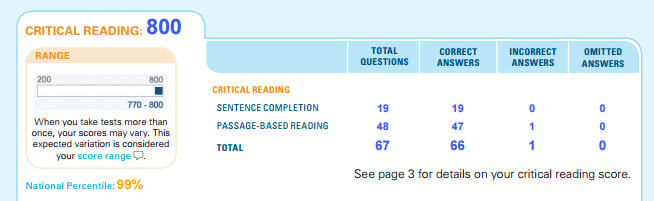
Strategies to Become a Perfect Sabbatum Reading Score

Strategy 1: Understand Your High Level Weakness—Fourth dimension Management or Passage Strategy?
Strategy 2: Learn to Eliminate 3 Wrong Answers

Incorrect Reply 1: Also Specific
Wrong Respond 2: Too Broad
Wrong Answer three: Reversed Relationship

Wrong Answer four: Unrelated Concept
Strategy 3: Predict the Answer Before Reading the Reply Choices


Strategy four: Experiment With Passage Reading Strategies and Find the Best for You
Passage Method 1: Skim the Passage, Then Read the Questions

Passage Method ii: Read the Questions First and Marker the Passage


Passage Method three: Read the Passage in Detail, Then Answer Questions
Choose Which Works Best for You, Based on Test Data

Strategy five: Understand Every Single Mistake You Make
#one: the gist of the question
#2: why you missed information technology, and
#iii: what yous'll practise to avert that mistake in the future.
Take separate sections past question type (vocab questions, large moving picture questions, inference questions, etc).
Ever Go Deeper—Why Did Yous Miss a Reading Question?

Bonus Tip: Re-Solve the Question Before Reading the Answer Explanation
Strategy 6: Find Your Reading Skill Weaknesses and Drill Them

Strategy 7: Read the Italicized Passage Introduction

Strategy 8: Be Interested in the Passage Subject Thing


Strategy 9: Don't Spend Fourth dimension on Vocab
Strategy 9B: Don't Spend Fourth dimension Reading Books or Magazines

Strategy x: Cease With Actress Fourth dimension and Double Check
 Kind of like Neo seeing lawmaking in The Matrix.
Quick Tip: Bubbles Answers
Strategy 11: Be Gear up for Turbulence in Scores
In Overview
Strategy 2: Learn to Eliminate 3 Wrong Answers
Strategy 3: Predict the Respond Before Reading the Respond Choices
Strategy 4: Experiment with Passage Reading Strategies and Observe the Best for You
Strategy v: Sympathize Every Unmarried Error You Make
Strategy half dozen: Find Your Reading Skill Weaknesses and Drill Them
Strategy 7: Read the Italicized Passage Introduction
Strategy 8: Be Interested in the Passage Subject Thing
Strategy ix: DON'T Spend Time on Vocab
Strategy 10: Cease With Actress Fourth dimension and Double Check
Strategy xi: Be Ready for Turbulence in Scores What's Adjacent?


As co-founder and caput of product design at PrepScholar, Allen has guided thousands of students to success in Sat/Act prep and college admissions. He'due south committed to providing the highest quality resources to help you succeed. Allen graduated from Harvard University summa cum laude and earned 2 perfect scores on the Sabbatum (1600 in 2004, and 2400 in 2014) and a perfect score on the Human activity. You tin likewise discover Allen on his personal website, Shortform, or the Shortform blog.
Reading Staar Test Strategies for High School
Source: https://blog.prepscholar.com/how-to-get-800-on-sat-reading-10-strategies-by-a-perfect-scorer
0 Response to "Reading Staar Test Strategies for High School"
Post a Comment